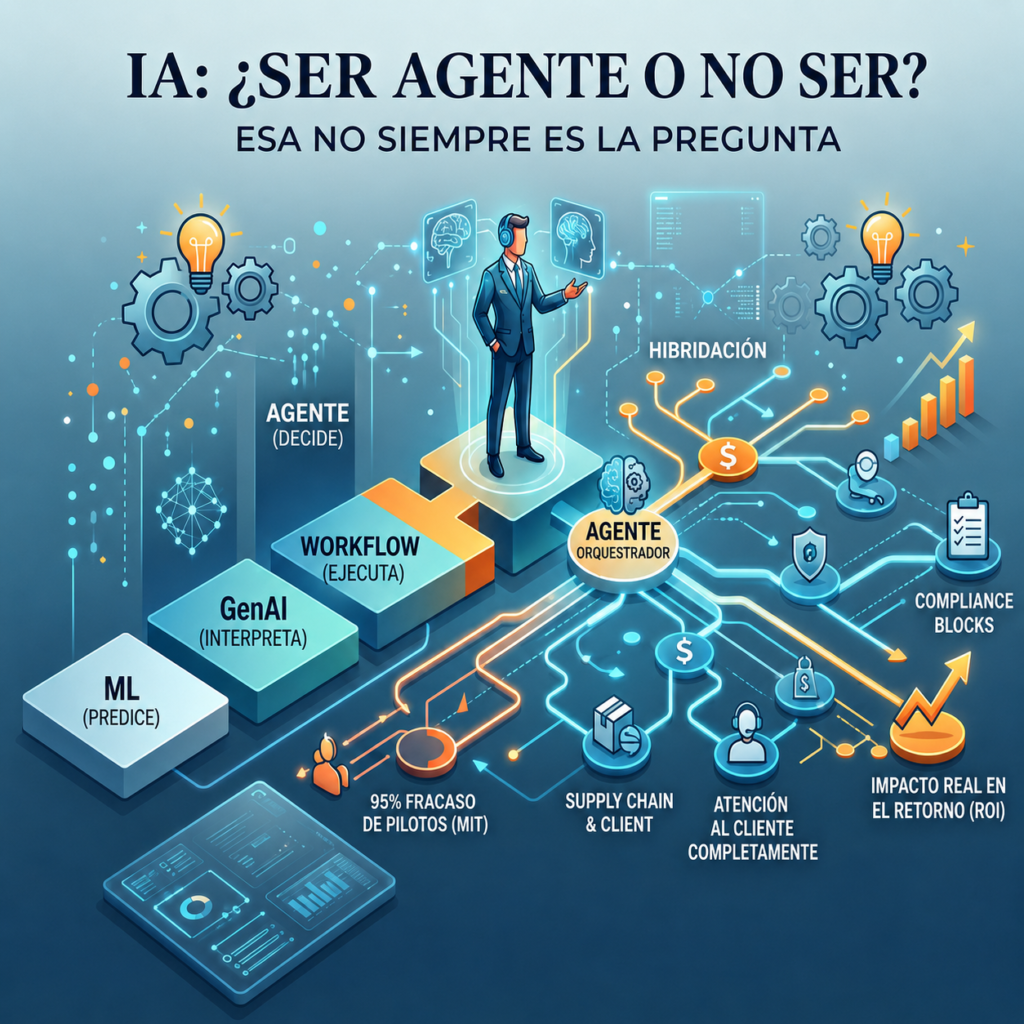
In the middle of the Generative AI “gold rush”, it seems that if you are not building “autonomous agents”, you are already falling behind. But the reality is harsh: according to MIT, 95% of corporate AI pilots fail.
Why? Because organisations often ask, “Can we do this with an agent?” instead of “What level of intelligence creates real value here?”
This article explores how Datadope approaches failure in AI pilots through a pragmatic methodology based on return on investment and the principle of the “Minimum Viable Level of Intelligence”.
Throughout the text, we break down the strategic differences between predicting (ML), interpreting (GenAI), executing (Workflow) and deciding (Agent), highlighting that autonomy is only justified when it fulfils the “10x rule” in efficiency or quality. To achieve this, we introduce the Trial Canvas, an objective assessment framework that evaluates KPIs, behavioural complexity, variability and risks to determine whether an architecture should be agentic or hybrid. The ultimate goal is to move beyond the technology “WOW” effect and focus on real, measurable impact at operational scale.
The Evolution of Models: Objectives and Purposes
At Datadope, we do not think about the tool before understanding the problem to solve. Success does not lie in using the most complex model, but in finding the balance that maximises return impact. To achieve this, we define clear objectives for each level:
- ML (Predicts):
- Objective: Statistical efficiency and anticipation.
- Purpose: Transform historical data into competitive advantage by detecting patterns (demand, fraud, churn). The value lies in precision and reducing uncertainty.
- GenAI (Interprets):
- Objective: Contextual understanding and accessibility.
- Purpose: Act as a bridge between unstructured information and humans. It enables summarisation and knowledge extraction naturally, drastically reducing friction in the analysis of complex data.
- Workflow (Executes):
- Objective: Determinism, security and auditability.
- Purpose: Orchestrate processes with structured logic where error is not an option. It is the foundation of scalable operations, ensuring that processes follow critical compliance and business rules.
- Agent (Decides):
- Objective: Adaptability in the face of ambiguity.
- Purpose: Handle situations where there is no linear playbook. The system has the autonomy to choose the path or tool required to resolve an exception in real time.
Focus on Value: The Datadope Approach
At Datadope, our philosophy is pragmatic: technology is not an end in itself, but a means to achieve return. While the market is distracted by the “WOW” effect of agents, we focus on TCO (Total Cost of Ownership). Implementing an agent is not just about programming it; it also involves maintaining it, supervising it, and paying for token consumption and latency.
- The paradox of traditional automation vs. Agentic AI: Traditional automation has a low fixed cost, but its marginal cost is infinite (it simply cannot resolve what it has not been programmed to do). An AI Agent, on the other hand, has a higher initial and maintenance cost, but drastically reduces the cost of handling variability. Our job is to find the balance point where autonomy genuinely saves money.
- The “Minimum Viable Level of Intelligence” principle: We do not use a sledgehammer to crack a nut. If a problem can be solved with a decision tree (Workflow), we do not introduce the uncertainty of a language model. Intelligence should be only as advanced as necessary to achieve the objective with the lowest operational risk and cost.
- The 10x rule: An agent must generate an order-of-magnitude improvement in efficiency, quality or scale. If the improvement is only incremental (10% or 20%), technical complexity and the risk of operational “hallucinations” will ultimately consume the ROI. At Datadope, we only scale towards autonomy when the impact is transformative.
The Trial Canvas: Our Decision Filter
To move beyond intuition and rely on data, we use our Trial Canvas. It is an evaluation framework where we score each initiative from 1 to 5. Only if the weighted average exceeds 3.2 points do we move towards an Agent architecture.
Here are the four critical dimensions we analyse:
- KPIs – Objective and Opportunity (Weight 15%)
- We analyse which business metric will be impacted: direct cost savings, improved response quality, or massive scalability? Without a clear KPI, there is no project. We look for opportunities where the cost of inaction is high.
- Dominant Behaviour (Weight 45%)
- This is the determining factor. We classify the challenge: is it predicting data (ML), interpreting a document (GenAI), executing a process (Workflow), or deciding a course of action in the face of ambiguity (Agent)? The more “decision-making” outweighs “execution”, the higher the score for becoming an Agent.
- Frequency and Dynamism (Weight 30%)
- We evaluate the Volume vs. Exceptions equation . If a process changes frequently or is full of “edge cases” that take humans hours to resolve, Agentic AI shines. If the process is static and high-volume, a traditional Workflow will always be more profitable and secure.
- Risk and Compliance (Weight 10%)
- What happens if the system fails? We analyse the impact in exceptional scenarios and the governance required. In highly regulated environments, we penalise total autonomy in favour of hybridisation: agents acting as orchestrators, but under deterministic guardrails (Compliance Blocks).
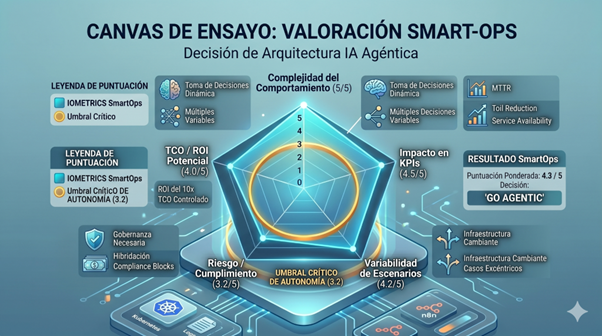
Why is IOMETRICS® Smart Ops based on autonomous agents?
To validate our IOMETRICS® Smart Ops product, our incident resolution assistant for SRE engineers, we applied our Trial Canvas. Only if the weighted score exceeds 3.2 points do we justify the move to an agentic architecture.
Here is the breakdown of why Smart Ops is the perfect candidate:
- KPIs – Objective and Opportunity (Weight 15%) – [Score: 4.5/5]
-
- Analysis: The objective is to drastically reduce MTTR (Mean Time To Resolution) and toil (repetitive work) for SRE profiles. The scalability impact on the availability of critical systems fully justifies the investment.
- Dominant Behaviour (Weight 45%) – [Score: 5/5]
-
- Analysis: A production incident does not follow a linear recipe. Smart Ops must decide which logs to consult, which observability metrics to correlate, and which diagnostic tools to use based on what it discovers. Dynamic reasoning is the core of the product.
- Frequency and Dynamism (Weight 30%) – [Score: 4/5]
-
- Analysis: Cloud Native infrastructures are constantly changing. A rigid workflow would break with every deployment. We need an agent capable of understanding changing contexts and adapting to new network topologies or services without manual reprogramming.
- Risk and Compliance (Weight 10%) – [Score: 3/5]
-
- Analysis: The risk of production error is high, which is why we apply Hybridisation. The agent decides the diagnosis, but the execution of changes takes place through protected Workflows (guardrails), ensuring that autonomy does not compromise stability.
Trial Canvas Result: 4.42 / 5.0 ➔ Go Agentic.
The Golden Criterion: The 10x Rule
Smart Ops is not agentic because “we can” do it, but because it is the only way to scale operational intelligence with real ROI. We apply TCO (Total Cost of Ownership) logic: the cost of maintaining the system is offset by a tenfold impact on efficiency and cost savings from service outage reduction.
Conclusion: Towards Hybridisation
The market trend is not total and blind autonomy, but hybridisation. The most valuable agents today act as workflow orchestrators: AI interprets intent, while structured and measurable flows execute the action.
At Datadope, integration and measurable outcomes are what matter. Less “WOW” and more real impact.
Horacio Enrique Suárez.
Datadope