

The End of the Firefighting Era
In the fast-moving world of tech operations, complexity has grown faster than our ability to manage it. Today, Site Reliability Engineering (SRE) teams are trapped in a maze of microservices, alert storms, and repetitive manual work—better known as toil—that drains the business with every second of downtime. As much as 80% of their day is spent resolving incidents reactively, leaving barely 20% for strategic innovation.
But what if you had an expert sidekick working 24/7—one capable of diagnosing complex failures and accurately explaining their root cause before the customer even notices? In this article, we introduce IOMETRICS® SmartOps, Datadope’s solution for transforming incident management from reactive to autonomous and explainable.
What is IOMETRICS® SmartOps? The AI Sidekick for SRE Teams That Keep Systems Reliable
This is not a traditional monitoring tool. It is a collaborative, multi-agent, agnostic AI platform that acts as the SRE engineer’s sidekick at virtually unlimited scale—with one critical difference: unlike black-box solutions, SmartOps is designed to explain the reasoning behind every diagnosis. The real innovation behind IOMETRICS® SmartOps lies in three technological pillars that work together to reason, act, and evolve.
Pillar 1 — Collaborative Multi-Agent AI
The platform moves beyond the single-agent model by deploying specialized roles for every incident.
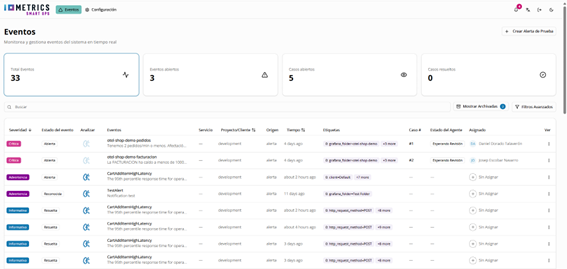
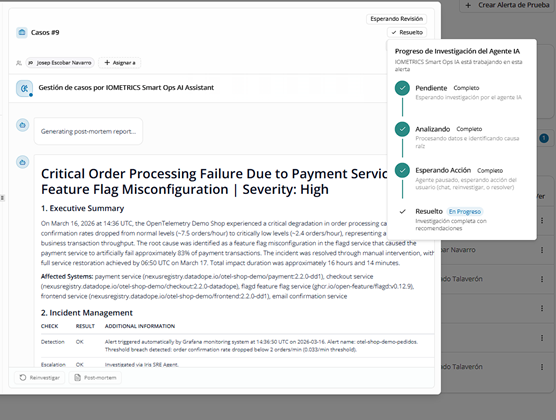
When a crisis is detected, the Agents take command at the direction of the SREs and orchestrate the full diagnostic workflow, leveraging other tools and acquired skills that monitor specific technical areas—databases, networks, and infrastructure. These agents detail the evidence, verify its authenticity, and prepare a comprehensive root cause analysis report suggesting a solution.
From that moment on, they become a valuable partner to the engineers, capable of verifying every piece of information and accelerating the incident resolution speed thanks to their diagnosis. Upon completion, a detailed post-mortem is generated, providing an end-to-end view of the entire process, from detection to resolution.
All of this collaboration is orchestrated through an asynchronous messaging architecture that ensures resilience and horizontal scalability.
Pillar 2 — Causal Reasoning
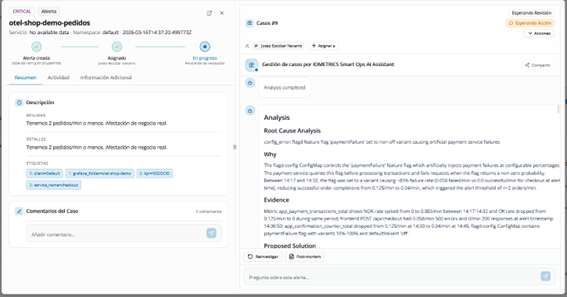
To turn context into concrete solutions, SmartOps implements a causal reasoning engine, overcoming the limitations of tools that only detect superficial statistical correlations. When a symptom appears, the platform reviews the context, generates multiple hypotheses in parallel, and rigorously tests them against the evidence, validating both the temporal sequence of events and the logic of topological dependencies.
The system uses counterfactual reasoning to refute incorrect theories and filter out false positives. Unlike black-box solutions, this reasoning is fully transparent: every conclusion is presented with an explanatory trace that details the logical path followed through the graph, allowing engineers to validate every step of the diagnosis.
Pillar 3 — Continuous Learning and Improvement
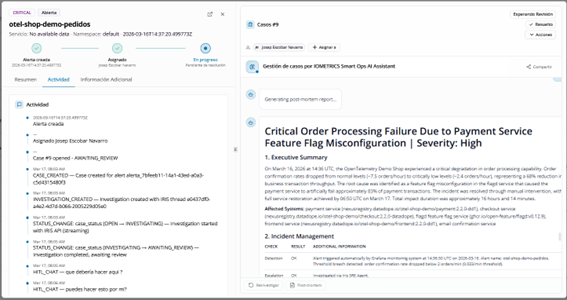
SmartOps ensures that the platform does not remain locked in its initial state, but instead evolves with every interaction. Every resolved incident is recorded, creating a shared operational knowledge base that enables the system to recognize similar issues instantly in the future.
This pillar is powered by human feedback: engineers’ validation becomes active training that fine-tunes the agents’ confidence models. Through machine learning and adaptive prompt optimization, SmartOps selects the most accurate algorithms and models for each case. In this way, expert knowledge is codified and scaled, turning operational experience into an institutional asset that is not lost through staff turnover.
Results That Transform Organizations
Implementing autonomous agents goes far beyond a simple technology upgrade; it is an operational and financial decision that fundamentally transforms the day-to-day reality of any company.
Imagine a crisis scenario that, in the past, would have brought your operations team to a standstill. Before, engineers could spend hours in endless war rooms trying to trace the source of a failure. Today, with IOMETRICS® SmartOps in the loop, that same complex investigation becomes a surgical-precision diagnosis completed in under 20 minutes.
This unprecedented speed is made possible by up to an 80% reduction in the time required to complete root cause analysis (RCA). By removing guesswork and addressing problems directly at their source, organizations can cut Mean Time to Resolution (MTTR) by up to 66%. For end users, that translates into far stronger service availability and a user experience no longer disrupted by prolonged outages.
But the real transformative impact happens on the front lines, in the day-to-day work of technical teams. By offloading heavy investigative work to AI and automating repetitive manual toil, SmartOps creates a complete paradigm shift for SRE teams: they stop being exhausted firefighters responding to emergencies and evolve into true system architects. With all that recovered time, human talent can finally focus on continuous improvement, innovation, and generating real, measurable ROI for the business. In short, the reactive chaos of alert overload gives way to operations that are resilient, controlled, and predictable.
AI Where You Work: No Black Boxes
SmartOps integrates with your existing ecosystem, so your teams do not have to jump between tools. Through its web console and ChatOps capabilities, it enables engineers to audit every step of the investigation, approve corrective actions, and add critical human context. The philosophy is clear: augment people, not replace them—freeing their talent to innovate instead of constantly putting out fires.
Conclusion: The End of Hero Dependency and the Beginning of Resilience
Ultimately, the evolution proposed by IOMETRICS® SmartOps goes far beyond a simple update to your tooling stack; it represents a profound shift in the way operations are run. Moving beyond the era of chaos means no longer depending on the heroics of a few experto to keep critical systems running. By embedding an autonomous, collaborative ecosystem at the heart of operations, companies do more than safeguard business continuity—they fundamentally reshape the role of their technical teams.
The real value of this platform lies in putting people back in control: enabling SREs to finally step out of constant reactive mode, lead strategic innovation, and design architectures that are resilient by design.
Collaborative Multi-Agent AI: The New Brain Transforming System Reliability

